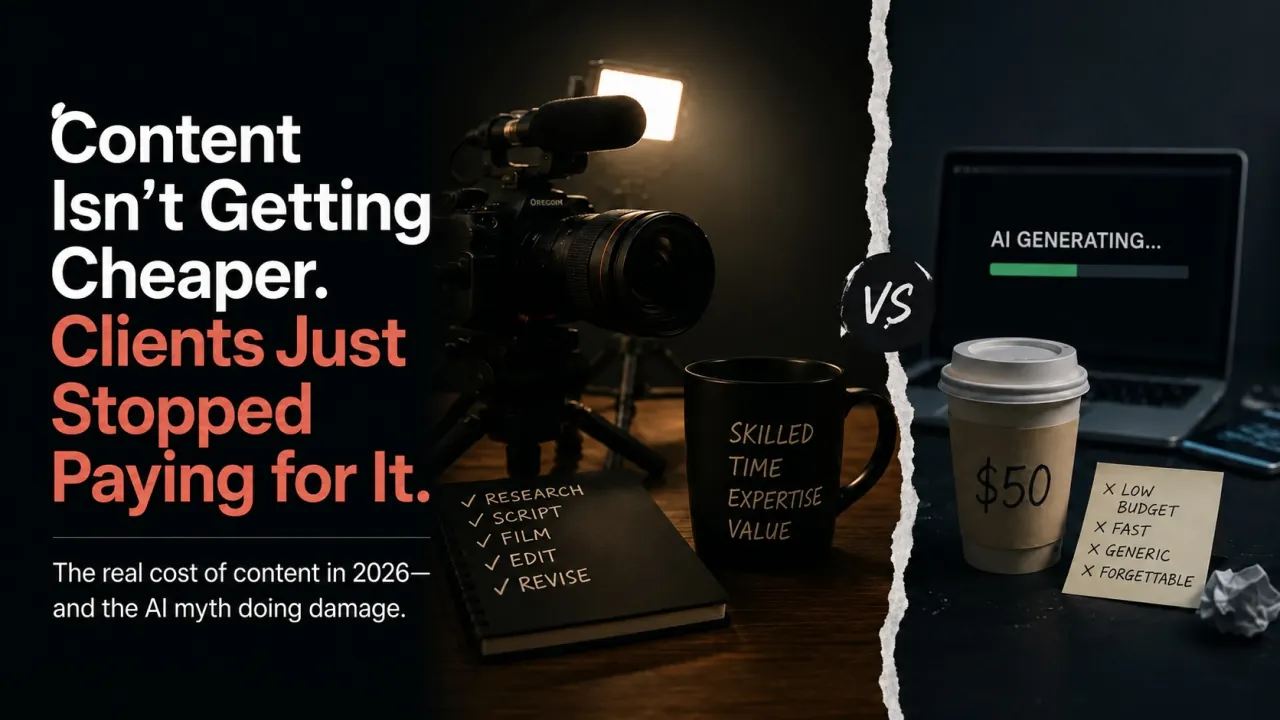
A version of this brief turns up all the time: "We need a 60-second UGC video. Product showcase, natural feel, authentic tone. Budget: $50." That fee is meant to cover someone understanding the product, writing or improvising a script, filming, lighting, recording sound, editing, revising and delivering in a format the client never specified.
Making content hasn't got cheaper. Some clients have decided creative work no longer needs paying for, and they use "AI can do it anyway" as the justification.
What does a UGC video cost to make?
Here is the time a single 60-second UGC video takes, the kind brands request every day.
| Stage | Time |
|---|---|
| Research and brief review | 30 to 60 minutes |
| Concept and scripting (even "natural" content has a structure) | 1 to 2 hours |
| Setup, filming and multiple takes | 1 to 2 hours |
| Editing, colour, captions and sound | 1 to 2 hours |
| Client revisions, usually at least one round | 30 to 60 minutes |
| Total | 4 to 7 hours |
At $50, that works out below minimum wage in most developed markets, paid to someone with a camera, an audience, a feel for how each platform works and the ability to make a product look desirable on screen. The rate says nothing about the cost of the work. It shows the client assumes the work has none.
Why do lowball briefs cost brands more?
Experienced creators turn the brief down. They know what their time is worth and move on to clients who do too.
The job goes to someone still building their skills, with less experience and less sense of what makes content work. They film it in twenty minutes, it looks cheap because it was cheap, and it performs like a $50 video. The brand decides UGC doesn't work for them, when the budget was the problem. They pay twice: once for the weak video, and again in lost performance.
The longer-term damage spreads across the market. When enough brands push $50 and enough creators accept it out of necessity, the industry learns that this work is worth nothing. Skilled people leave, the quality floor drops, and brands wonder why the creator economy stopped producing interesting work.
Is AI content cheap to make?
No. The tools alone, from Runway, Sora and Midjourney to ElevenLabs, Kling and whatever connects them, cost real money at any meaningful volume. A serious AI content workflow running at scale can easily cost hundreds to thousands of dollars a month in subscriptions before anyone has been paid.
The bigger cost is the person running it. Someone has to:
- pick the right tool for each job
- write prompts that produce on-brand output instead of generic noise
- design a workflow that can be repeated
- review every output with editorial judgement
- catch what the model got wrong, whether that is an off-brand line, an uncanny detail or a tone that misses the audience
That is skilled work, different from before and still priced like skilled work. Anyone can generate fifty caption variations now. Choosing the one with a voice, the one that will land, is the part that can't be automated, and brands that skip it end up with feeds full of content that seems made by something that has never felt anything.
What does good content cost in 2026?
With or without AI, the cost of content comes down to time and expertise. AI changes the shape of the work, compressing some tasks and creating others. A skilled strategist using AI can produce more in a day than before, but they are still the one deciding what good looks like for this brand, this audience and this moment.
| Approach | What to budget for |
|---|---|
| UGC from a skilled real creator | $300 to $800 per video is a reasonable professional rate, and some creators rightly charge more |
| AI-assisted content at volume | Tools, the strategist or creative director running the workflow, and quality control. The per-video cost can fall, because the expertise is paid for upfront to build the system |
The brands getting this right aren't hunting for the cheapest option. They treat content as a cost of acquiring customers, and they know cheap content ends up costing more than it saved at the brief stage.
What should brands, creators and tool builders take from this?
- Brands: before sending a $50 brief, consider what it tells the people making things for you about how you value their work, and whether that is the relationship you want.
- Creators: treat a $50 brief as a signal. Your time has a floor, and it helps to know where it sits.
- AI tool builders: "look how cheap this is" is the wrong pitch. "Look how much further your budget goes when it is spent well" is a more honest one.
We price AI UGC ads and creator content at Original Copy around the work involved. If you want to see how that breaks down for your brand, talk to us.