We started thinking about this after reading about NVIDIA's RTX Spark. The hardware matters less than the direction it points in: AI that runs beside your work, on your own machine, rather than somewhere else entirely. When that shift fully arrives, it will change how creative teams work more than any benchmark gain.
How much of an AI workflow is waiting?
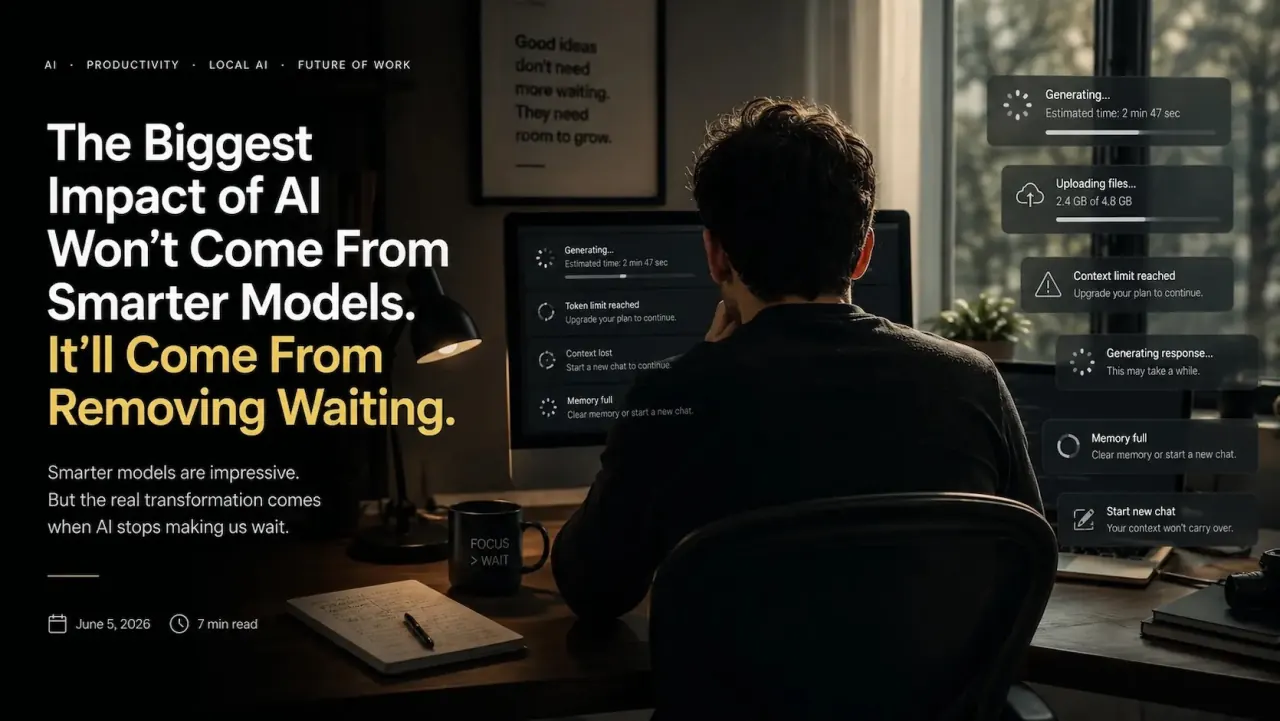
More than most heavy users admit. A working day with AI fills up with waits: for a generation to finish, for an upload to complete, for a token limit to reset, or for a fresh chat after the model lost track of the project and everything had to be explained again.
Teams have quietly built their workflows around those limits. They compress files, split projects into pieces, trim context and rewrite prompts, so the attention that should go into the work goes into fitting the work inside the tool. Half the job becomes looking after the AI.
What is tokenmaxxing?
Tokenmaxxing is our name for the moment an AI system's limits start making creative decisions for you. You cut context because space is running out, not because it is irrelevant. You restructure a project to fit a limit rather than to think more clearly. You spend more effort managing the model's memory than doing the work.
Some people call this prompt engineering, which makes it sound like a skill. Most of the time it is a workaround, and it taxes every interaction. The more complex the work, the heavier the tax, because long-running projects with real depth are exactly what context windows were never built for. Somewhere along the way, people stopped asking AI to help them think and started asking it to help them survive its own limits.
What changes when AI runs next to your work?
Moving from cloud AI to local AI changes the relationship with the tool, and the specs are the smaller part of it. Cloud AI today is like a brilliant assistant who forgets everything at the end of each meeting. You brief it again every session and carry the context yourself, because your files, projects and history don't come with you.
Local AI keeps that context. Your files and work history stay available, and the model knows where you left off without being told. It stops being something you log into and becomes something that runs alongside everything else you do.
Remove that friction and habits change. Ideas no longer need protecting from the cost of explaining them again, so people follow threads they would once have dropped because starting over felt too expensive.
Why does fast generation change creative work?
Speed changes what gets attempted. Slow generation puts a cost on every idea: you wait, assess and iterate, so you commit to fewer directions. When generation is fast enough, a team can explore five hundred ideas instead of five and test thirty directions instead of three. Creation becomes cheap, close to free, and that moves the bottleneck somewhere else.
What becomes the bottleneck?
Judgement. When AI can generate almost anything, the valuable skill is knowing which outputs are worth keeping, which ideas are worth building and which to ignore.
For most creative and knowledge work, production has been the constraint: getting the idea out of someone's head and into the world. AI has already started moving that constraint, and fast, local, always-on AI will finish the job. What remains is the ability to look at a hundred outputs and pick the one that is right for this audience and this moment, beyond technically correct or merely competent. That is a deeply human skill, and AI makes it more valuable.
Why taste is the skill to train now
The most valuable people in creative work over the next few years may not be the best prompters or the ones with the most powerful hardware. They are more likely to be the ones with the best taste: the ability to find the one strong idea among hundreds of average ones, and to tell work with soul from work that is technically impressive and emotionally empty.
When every team has the same models and the same compute, output volume stops being an advantage, and knowing what is worth producing becomes the edge. A team without taste finds that AI shows it up faster than ever.
Taste is not a technical skill. Nobody can prompt for it or fine-tune their way to it. It comes from long exposure to great work and from strong opinions held and revised over time, which takes years. That is the case for building it now, before everyone realises it is the thing that matters.
What this means for brands
If generating content becomes cheap and fast, the brands that stand out will be the ones whose teams and partners can tell good work from competent work. When you brief a studio or hire a creative lead, ask how they decide what to keep, as well as what they can make.
That is how we run Original Copy. We use AI for speed on AI UGC ads and content production, and put the time it saves into the decisions it can't make. Our explainer on the race to build AGI follows the same argument through to where the industry is heading.