- AI is what made AI hardware expensive. Standard DRAM is heading for roughly five to six times what it cost in mid-2025, and Nvidia's DGX Spark has gone from $3,999 at launch to about $6,950.
- The models a team can run in-house are months behind. On a 128 GB machine the best one scores 40 on Artificial Analysis's index against 58 for Claude Opus 5.5: close on long documents, far behind on agentic coding.
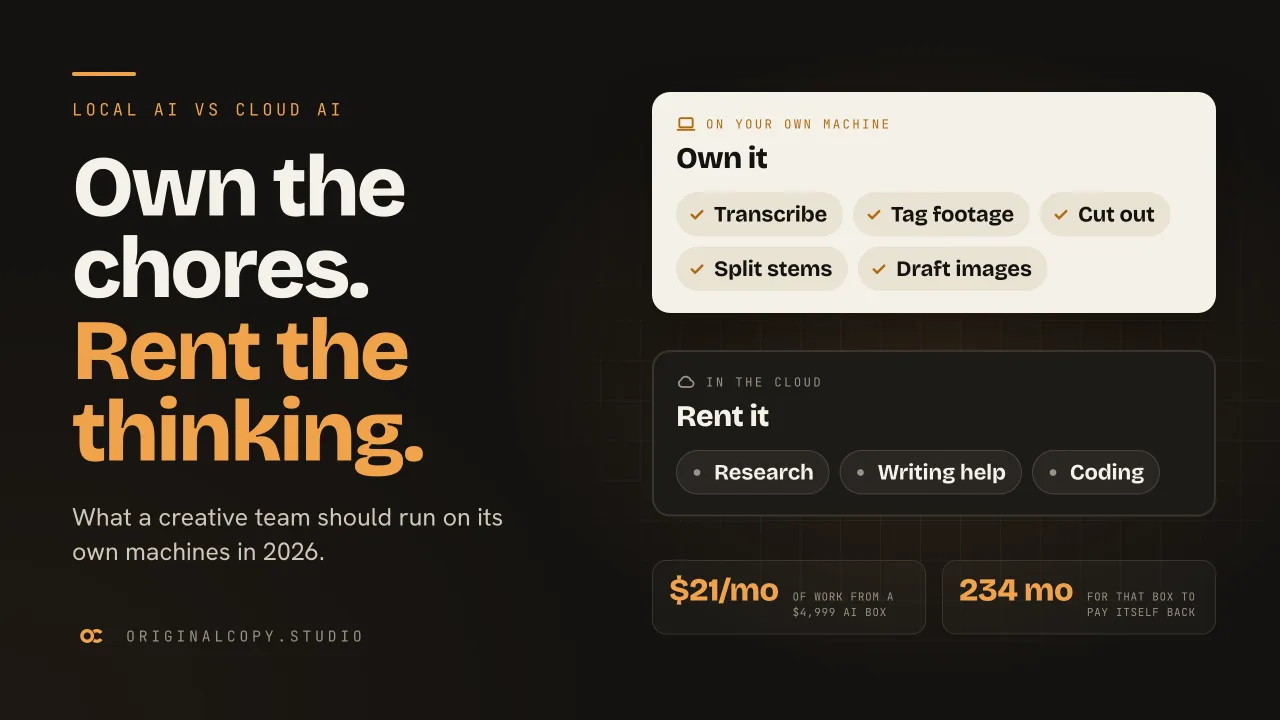
- The payback rarely adds up. Valued at what the same open model costs to rent online, a $4,999 DGX Spark produces only about $21 a month of output.
- Client data is the strongest reason to go local. Consumer AI plans can keep or train on what you upload, and footage that stays on your own drive never raises the question.
- The split that works for most teams is business-grade cloud plans for thinking and coding, and local machines for the chores.
The video version, presented by our co-founder Kurt Loy. 10 min 6 sec. Watch on YouTube
- 0:00The $5,899 AI laptop that sold out
- 0:59Why RAM prices exploded
- 2:49How local AI works: the model has to fit
- 4:34One model, five machines: tokens per second
- 6:04Does a local AI box pay for itself?
- 7:38Local AI vs cloud AI: where local wins
- 9:34My verdict: own the chores
Most of this year's "is local AI worth it" videos ask whether a computer at home can replace a coding subscription like Claude Code. A creative or marketing team has a different question. Which of its daily jobs can run on its own machines, which still need the cloud, and is any new hardware worth buying while prices are this high?
Part of our own studio's pipeline already runs on a MacBook Air, so some of this comes from use as well as research. This is the written version of the video above, for teams that make content. We gathered prices and benchmark speeds in the middle of October 2026, every figure carries a date, and the sources are at the end.
Why is AI hardware so expensive in 2026?
Memory is the reason. AI data centres are buying most of what the memory makers can produce, so everything else with memory inside it costs more.
Going by TrendForce's contract prices, a gigabyte of standard DRAM will cost five to six times its mid-2025 price by December. AI accelerators rely on high-bandwidth memory (HBM), stacked in layers, and Micron says each gigabyte of it uses roughly three times as much silicon wafer as regular DDR5. HBM already takes around 20% of global DRAM wafer output, and Samsung expects close to 30% next year. Meanwhile the nine biggest cloud operators are on course to spend about $957 billion on data centres and equipment this year, by TrendForce's count, and suppliers fill their orders before anyone else's.
Suppliers have little left to sell. Micron's quarterly revenue reached $54.2 billion, nearly five times the $11.3 billion of a year before, and over three quarters of what it plans to make in 2027 is already allocated. SK hynix's chief executive has warned that 2027 will bring the tightest supply the industry has ever seen.
It shows up on every hardware quote. The cheapest Mac mini went from $599 in 2024 to $899 for the new M6, a 32 GB DDR5 memory kit averaged $572 in August against $108 a year earlier, and on Apple's July earnings call Tim Cook compared memory pricing to a 100-year flood. These are the machines a team would look at for local AI, priced in October 2026, with how fast each runs the same mid-sized open model.
| Machine | Qwen 3.8 27B, tokens a second | Memory | Price, October 2026 |
|---|---|---|---|
| Apple Mac mini (M6) | 10 to 21 | 32 GB | $1,299 |
| Mini PC with AMD Strix Halo | 12 to 33 | 128 GB | From about $3,100 |
| Nvidia DGX Spark | 12 to 20 | 128 GB (a 64 GB version is $4,999 from 23 October) | About $6,950 |
| Apple Mac Studio (M5 Ultra) | 39 to 48 | 96 GB base, 256 GB as tested | From $5,499 |
| Desktop with an Nvidia RTX 5090 | 51 to 59 | 32 GB on the card | Card from $4,921 (list price $1,999) |
A token is roughly three quarters of an English word. Microsoft's Surface Laptop Ultra, due to ship on 16 October at $5,899 for the 128 GB version and reportedly already sold out on Microsoft's US store, had no independent speed tests when we gathered these figures. Going by its memory bandwidth, we'd expect it nearer the DGX Spark than the RTX 5090 desktop.
What can local AI models do well?
Reading. They come close to the best cloud models at working through long documents, and fall well short when asked to run a multi-step task on their own.
A model only runs if the whole file fits in the machine's memory. Compressed to 4-bit, the usual format for home use, it takes roughly half a gigabyte for each billion parameters. Take Qwen 3.8 27B, a widely used open model: it shrinks from 55 GB to 17 GB and lost little quality in Quesma's tests, so a 32 GB computer can hold it. Its big sibling, Qwen 3.8 Flash-Next, carries 125 billion parameters and needs around 100 GB, the reason people pay for 128 GB machines. Only about 6 billion of its parameters work on each token, so it runs quickly, but every one of them still has to be loaded.
Artificial Analysis scored these models in October 2026. Claude Opus 5.5 reaches 58 on its overall index, Flash-Next 40 and the 27B model 34, which leaves the best home-sized models roughly three to six months behind the cloud. The gap depends on the job. On Artificial Analysis's long-document reading test the local models land at 80 and 82, against 85 for Opus 5.5. On Terminal-Bench, which measures an AI working through a coding task by itself, they score 25% and 6% against Opus 5.5's 60%.
For a creative team, that makes reading, summarising, tagging and transcribing fair work for a local model, and keeps anything agentic in the cloud.
How fast are local AI models?
They're quick once they start, and slow to start on long prompts. Two measurements matter: how fast the answer streams out, which depends mostly on memory bandwidth, and the pause while the machine processes your prompt before producing anything, which depends on raw computing power.
Software moves the first number almost as much as hardware does. NightShift Tech's Mac mini went from 9.6 to 21 tokens a second when it switched the engine that runs the model and changed nothing else. MacStories clocked the Mac Studio at a median 108 tokens a second on Flash-Next, helped by how few parameters that model activates per token.
The wait before the first word is where home machines struggle. Claude Code sends about 33,000 tokens of its own instructions with every request. In NetworkChuck's test, a 32,000-token prompt took 21 seconds on the Mac Studio before any output appeared, Local Explained estimates 25 seconds to about a minute on a DGX Spark, and one home user waited nine minutes on a 50,000-token prompt. A transcription or tagging job barely notices that delay. Back-and-forth work over long documents does.
Does an AI computer pay for itself?
Not for chat or coding. The usual sum sets the hardware against a subscription, and the subscription buys models the hardware can't run.
Compare Nvidia's new 64 GB DGX Spark ($4,999) with a $200 monthly AI subscription and the box looks paid off after 25 months. That subscription includes Claude Opus 5.5 or OpenAI's top model, though, and the box runs open models instead, which cloud providers rent out at roughly $0.47 to $3.20 for every million tokens. When Local Explained valued a DGX Spark's output at those rates, 11.6 tokens a second for eight hours on each of 22 working days came to about $21 a month, so the box would need 234 months to earn back its price. Kai repeated the exercise with a $1,299 Mac mini: 6.5 months by the simple sum, and about $15 a month of output in practice.
Teams pay per seat, which makes the box look worse. Claude Team and ChatGPT Business both start at $20 per user a month on annual billing, so a five-person team spends about $100 a month, and a $4,999 machine replaces none of those seats because it can't run the models inside them.
Power is close to a rounding error. Over a 176-hour working month at the average US rate of 18.31 cents per kWh, a 70-watt Mac mini costs about $2.26 to run and a 575-watt RTX 5090 desktop about $19. Resale favours local hardware while the shortage lasts. In October the three cheapest RTX 4090 listings on eBay came to about $3,111 on average, against a launch price of $1,599.
Draft video is the one creative job where the sums can work. Ten minutes of 720p draft video a month costs $60 to $72 on Google's Veo 3.1 Fast API and $240 on Veo 3.1 Standard, so a team that drafts a lot of video could see a local GPU pay back within a year, provided the local drafts are good enough to work from.
Which jobs should a creative team run locally?
The private, repetitive ones that don't need the best model. This is how common studio jobs compare, using the fastest local results we found and cloud prices from October 2026.
| Job | Local speed | Cloud cost | Where we'd run it |
|---|---|---|---|
| Transcription and subtitles | A 2 h 5 min shoot in 90 s on a Mac Studio M5 Ultra | $0.18 to $0.36 an hour by API; $24 to $35 a month for Descript | Local, for privacy and convenience |
| Tagging a footage library | About 7 min per hour of footage with an 8B vision model (Mac Studio M5 Ultra) | About $0.09 to $0.18 an hour on Gemini | Local for client footage under NDA |
| Draft images | About 1.8 s per image with FLUX.2 klein (Mac Studio M5 Ultra) | About $0.005 an image | Either; local allows endless iterations |
| Draft video | A 4 s clip with sound in 17.8 s with LTX-2.5 (Mac Studio M5 Ultra) | $0.05 to $0.40 a second | Local if you draft at volume, cloud for final quality |
| Splitting music into stems | About 28 s a track on an older mid-range GPU (RTX 2070 Super) | $7.50 to $15 a month | Local |
| Voice | 13 to 79 times real time with the open Kokoro model | $22 to $99 a month at ElevenLabs | Cloud for a cloned brand voice, local for scratch voiceover |
| Research, writing help and coding | 10 to 108 tokens a second, with long waits on big prompts | $20 to $200 a month | Cloud |
If your team edits in Premiere Pro, some of this is already on your machines. Its speech-to-text has run on-device since 2022, and Adobe says its Media Intelligence search works locally without an internet connection.
In our own studio, a MacBook Air M5 with 24 GB of memory transcribed an 11 min 14 s voiceover in 65.2 seconds with Whisper large-v3 on 14 October, and in 22.2 seconds with the faster turbo version. The same laptop handles photo cutouts and splits audio into stems, and none of that material gets uploaded. Others have made the same move. Jakub Jirák cancelled a $17-a-month transcription service after his Mac handled a 62-minute client call in 4 minutes 50 seconds, and says his client calls now never leave his SSD, so he no longer needs a data processing agreement.
Is local AI more private for client work?
Yes, because nothing leaves the machine. With cloud AI, privacy depends on the plan you're on, and consumer plans offer the least protection.
- Since its August 2025 terms update, Anthropic trains on chats from its consumer Claude plans (Free, Pro and Max) unless you opt out, and keeps opted-in data for five years. Its Team, Enterprise and API customers aren't affected.
- OpenAI doesn't train on data sent through its API by default.
- Google keeps Gemini chats that human reviewers have read, including reviewers at its service providers, for up to three years, even after you delete your activity.
- OpenAI was ordered to produce 20 million ChatGPT conversations, with personal details removed, as evidence in a copyright lawsuit, and a US judge upheld that order in January 2026.
- Netflix tells the companies producing for it that AI tools must not store, reuse or train on production inputs or outputs, and that unreleased assets need explicit sign-off.
A sensible rule for a team is that client material goes into business or API accounts whose data terms someone has read, or onto the team's own machines, and never into a personal consumer plan.
Can you rely on cloud AI plans?
Not to stay the same. These are the changes from 2026 alone.
| When | What changed |
|---|---|
| March | Claude's usage limits began running down faster during weekday peak hours |
| 24 September | OpenAI closed the Sora video API |
| 30 October | ChatGPT's $200 Pro plan drops to half its previous usage allowance |
| 1 December | Google doubles the API price of its flagship Gemini 4 Argon model |
| Announced | Daily usage limits on Apple's new Siri |
A model saved on your own drive only changes when you update it. The apps around it can still change their terms. Topaz ended perpetual licences in October 2025, and the $299 that used to buy Topaz Video outright now covers one year.
What we'd do now
Our advice for creative and marketing teams, as of October 2026:
- Keep a business-grade cloud plan for each person who does research, writing or coding.
- Move transcription, footage tagging, cutouts, stems and draft images onto machines you already own, starting with the on-device features in the editing software you pay for.
- Keep client material out of personal consumer AI plans.
- Don't buy a $5,000 AI computer to replace a $20 seat.
- If you have to replace hardware anyway, prioritise memory, since Micron expects 2027 and 2028 to be tighter still.
Before you buy anything, give one of the team's existing laptops a single routine job, such as transcribing this week's footage, and see how it copes.
Frequently asked questions
Is local AI worth it for a business?
Usually not as a way to cancel cloud AI. The best models in a business plan won't run on local hardware, and a $4,999 DGX Spark does only about $21 a month of chat work at rental prices. It is worth it for confidential, routine tasks such as transcribing, logging footage and drafting images, ideally on computers the team already has.
Should my team buy a DGX Spark, Mac Studio or RTX 5090 for AI?
Buy for a specific job, not the label. Running Qwen 3.8 27B, an RTX 5090 desktop is fastest at 51 to 59 tokens a second, a Mac Studio M5 Ultra manages 39 to 48 and a DGX Spark 12 to 20. The RTX 5090 has only 32 GB, though, so the Spark and the Mac Studio can load much bigger models. All three got more expensive in 2026.
How much memory do you need to run AI locally?
Roughly 0.5 GB for every billion parameters once a model is compressed to 4-bit, plus headroom for the prompt. That puts Qwen 3.8 27B at about 17 GB, workable on a 32 GB computer, and the 125-billion-parameter Flash-Next at around 100 GB, which takes a 128 GB machine.
Is local AI as good as ChatGPT or Claude?
Not across the board. Artificial Analysis gives Claude Opus 5.5 a 58 on its October 2026 index, and the strongest model that fits in 128 GB of memory gets 40, about three to six months behind. The local models are close on long-document reading, but as coding agents they score 25% against Opus 5.5's 60%.
Is local AI more private than ChatGPT?
Yes, because nothing leaves your machine. Cloud privacy depends on the plan: Anthropic trains on consumer Claude chats unless you opt out, while its Team, Enterprise and API customers are excluded, and Google keeps human-reviewed Gemini chats for up to three years. Client material is safest on your own machines or on business plans with terms you've checked.
Which AI jobs can a creative team run locally?
Subtitling, logging footage, cutting out photos, separating music stems and drafting images or short clips all work well on local hardware. A two-hour shoot took 90 seconds to transcribe on a Mac Studio M5 Ultra, and an 11-minute voiceover took 22 seconds on a MacBook Air M5. Keep research, writing help and coding in the cloud.
Why are computers so expensive in 2026?
AI is soaking up the world's memory supply. Each gigabyte of the HBM used in AI chips needs about three times as much wafer as ordinary DRAM, the cloud giants buy first, and standard DRAM is heading for five to six times its mid-2025 price by year end. That has pushed up the price of Macs, PCs, graphics cards and consoles.
Does a local AI computer pay for itself?
Seldom, if the job is chat or code. Compared with a $200-a-month plan, a $4,999 DGX Spark seems to pay back in 25 months, but priced against renting the same open model it produces about $21 of work a month, a 234-month payback. Draft video is the likeliest exception, because cloud video costs $0.05 to $0.40 a second.
Sources
We checked prices and speeds in mid-October 2026. Hardware prices are moving fast during the memory shortage, so check the date on anything you quote.
- Hardware prices: Guru3D on the Surface Laptop Ultra, BuySellRam on RTX 5090 prices, ServeTheHome on DGX Spark prices, The Register on the 64 GB DGX Spark, 9to5Mac on the M6 Mac mini, Engadget on the Mac Studio M5 Ultra, TechTimes on DDR5 kit prices, MacRumors on Tim Cook's 100-year flood
- Memory: TrendForce DRAM contract prices, Samsung on HBM's share of wafers, TrendForce on cloud capex, Micron earnings call, Tom's Hardware on SK hynix's outlook
- Models and speeds: Quesma on Qwen 3.8 27B at 4-bit, Unsloth on Flash-Next memory, Artificial Analysis leaderboard, NightShift Tech on the M6 Mac mini, kyuz0's Strix Halo benchmarks, MacStories on the M5 Ultra Mac Studio, NetworkChuck's M5 Ultra data
- Costs: Local Explained on DGX Spark payback, Kai on Mac mini payback, OpenRouter prices for Qwen 3.8 27B, Claude pricing, ChatGPT pricing, EIA electricity prices, GPU Poet on RTX 4090 listings, Gemini API pricing
- Creative jobs: Descript pricing, OpenAI API pricing, Gemini video understanding, fal on FLUX.2 klein, MISST on stem separation speed, LALAL.AI pricing, ElevenLabs pricing, Speech Technology on Premiere Pro speech-to-text, Adobe on Media Intelligence, Jakub Jirák on local transcription
- Privacy: Anthropic's consumer terms update, OpenAI on API data, Google on Gemini chat retention, ABA Journal on the 20 million logs, Netflix's AI guidance
- Plan changes: Claude's peak-hour limits, ChatGPT Pro usage halved, The Decoder on the Sora shutdown, MacRumors on Siri's limits, Topaz pricing
- Original post and video: Kurt Loy, Is local AI worth it? I did the math for creators