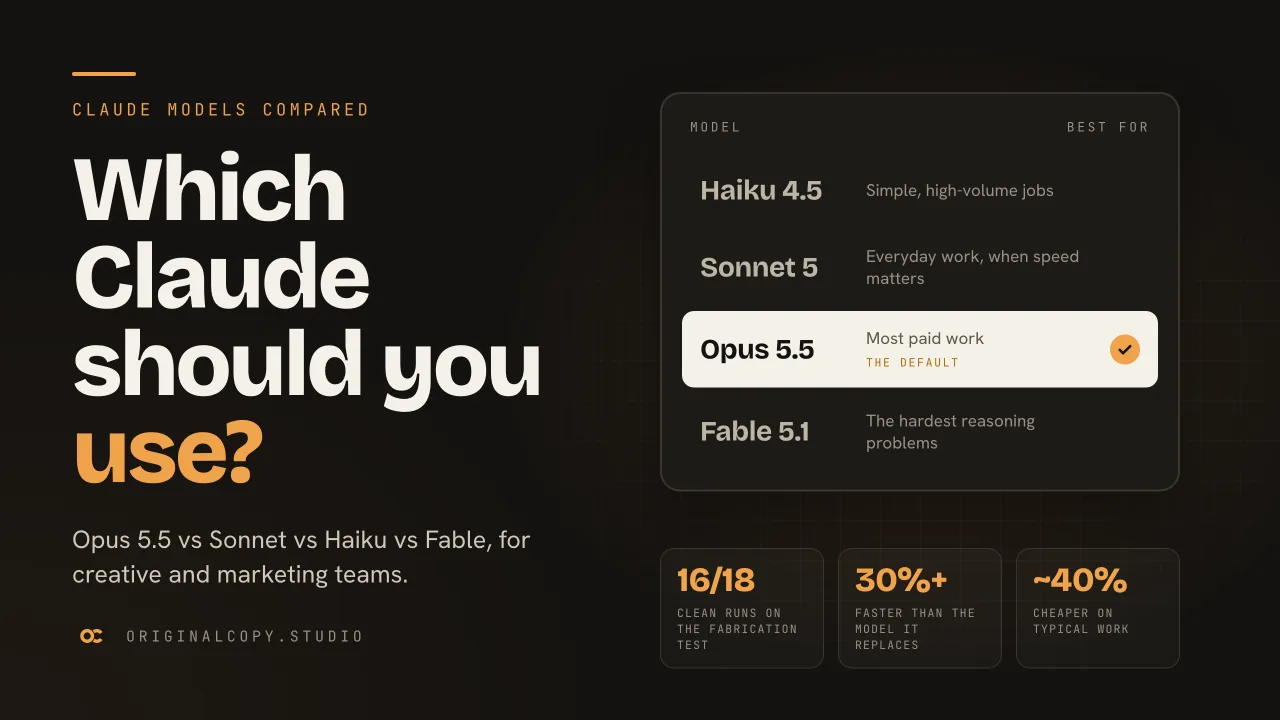
- On a paid plan, choose Opus 5.5. Anthropic's own documentation now tells unsure users to start there.
- On the free plan the choice is made for you: Sonnet for everyday work, Haiku for volume.
- The biggest improvement is honesty. On Anthropic's fabrication test Opus 5.5 passed 16 of 18 attempts, while Opus 5 and Fable 5.1 passed none.
- It also writes more like a person, runs more than 30% faster and costs about 40% less on typical work.
- It still cannot generate images, its browser control is uneven, and GPT-6 Astra beats it in two categories on Anthropic's own scoreboard.
The video version, 7 min 49 sec. Watch on YouTube
- 0:00Four Claudes
- 0:28What it is
- 1:03It writes like a person now
- 2:10It makes things up less
- 3:01It finishes things
- 3:59Faster and cheaper
- 4:39What it still can't do
- 6:06Which one to pick
- 7:22The honest version
The model menu in Claude lists four names: Haiku, Sonnet, Opus and Fable. It offers no guidance. Nothing is marked as recommended, nothing tells you which one burns through your quota, and most people never change whatever was selected when they signed up.
Anthropic released the newest of the four, Opus 5.5, on 22 September 2026. It is now their leading model, and it changes the answer to which one you should use. Below is what improved, what did not, and which model suits which kind of work. The figures were checked against Anthropic's own pages on 23 September 2026. Prices and plan limits move, so check the current number before you budget against it.
What is Claude Opus 5.5?
Opus 5.5 is Anthropic's leading model, released on 22 September 2026. It replaces Opus 5, which was out for about two months, and opens a new Claude 5.5 family. Sonnet 5.5 and Haiku 5.5 are due to follow with many of the same improvements. Anthropic has only said "in the coming weeks", so there is no date to plan around.
It is already live in the Claude apps, on the web, in Claude Code and on all three major cloud platforms. On a paid plan there is nothing to install. You pick it from the dropdown.
Claude models compared
| Model | Best for | Trade-off | Plan |
|---|---|---|---|
| Haiku 4.5 | Simple, repetitive, high-volume jobs | Fastest and cheapest, but the oldest of the four, so it knows least about recent events | Free and up |
| Sonnet 5 | Everyday work, and anything where speed matters | Quick and capable at a fraction of the price of the two larger models | Free and up |
| Opus 5.5 | The default for most paid users | Slower than Sonnet and much stronger. $4 and $20 per million tokens | Pro and up |
| Fable 5.1 | The hardest reasoning problems | The slowest of the four, at $10 and $50 per million tokens, roughly 2.5 times the cost of Opus 5.5 | Pro and up, using extra credits |
The plan column matters most. On the free tier, three quarters of this decision has already been made for you.
Which Claude model for which job?
For creative and marketing teams, the more useful question is which model is right for the task in front of you. This is how the four map onto typical work.
| The job | Use | Why |
|---|---|---|
| Client reports and summaries with figures or quotes | Opus 5.5 | It invents far fewer numbers than earlier models (16 of 18 clean reports against none) |
| Long, multi-step jobs you want to hand over | Opus 5.5 | It keeps working unattended and checks its own work |
| First drafts, brainstorms, quick rewrites | Sonnet 5 | Fast, capable and much cheaper, and you are going to edit the output anyway |
| Batch work: tagging, sorting, short variations | Haiku 4.5 | The fastest and cheapest option for simple, repetitive tasks |
| A hard problem Opus 5.5 has already failed on | Fable 5.1 | Deeper reasoning, at about 2.5 times the cost |
What changed in Opus 5.5?
It writes like a person
Anthropic says readability was one of the most common complaints about the previous model. Answers ran long, leaned on jargon and buried the point.
They published a before and after on the same bug report. The older model opens with a commit reference, then code, then a definition, then an operator, and reaches the conclusion near the end. The new one starts with the conclusion: a customer's bill dropped because of a bug in the billing code, the amount was $9.92, and here is the cause. Both find the same bug, but only one makes you dig for it.
Anthropic also describes it as less likely to reach for jargon or odd phrasing, and says it now follows the writing instructions you give it. One early tester summed it up as "it writes the way I do". For anyone writing copy with Claude, that point matters more than any benchmark.
It makes things up less
This is the most important change, and the easiest to miss, because an invented figure looks exactly like a real one on the page.
Anthropic built a test for it. Three models were asked to write a report on a company's earnings, working from a copy of the internet where the real earnings release was hard to find. A grader then checked every number and every quote against the source, and one invented figure failed the whole report.
Opus 5.5 passed 16 of 18 attempts. Opus 5 and Fable 5.1 passed none.
If anything Claude writes ends up in front of a client, whether that is a report, a summary or an email with your name on it, that gap is reason enough to switch.
It finishes long jobs
These tools have always been better at answering questions than at finishing tasks. Give one a whole job, walk away, and you usually came back to find it had stopped somewhere in the middle.
A developer at Clio gave Opus 5.5 work spanning six repositories and left it overnight, and it ran unattended for more than eighteen hours. A team at Quantium had a job that used to take 38 back-and-forth messages over four days. Opus 5.5 finished it in eleven prompts over three hours.
It also checks itself. Engineers at Column described it catching a misconfiguration introduced several commits earlier, by going off and reading the third-party documentation for that integration.
You do not need to write software for this to matter. A tool you have to supervise and a tool you can delegate to are different products, whatever the work is.
It is faster and cheaper
It produces output more than 30% faster than the model it replaces and costs about 40% less on typical workloads.
Through the API that is $4 per million input tokens and $20 per million output tokens, down from $5 and $25. On a subscription the saving shows up as headroom instead of a smaller bill. Anthropic raised the five-hour usage caps on Pro, Max, Team and seat-based Enterprise, and added a limit reset you can save and use when you need it.
What can't Claude Opus 5.5 do?
Three limits are worth knowing, because at least one launch-week review presented it as beating everything.
It cannot generate images. Claude reads images you give it well, but it cannot make one. ChatGPT has its own image model built in, so asking it for a picture gets you one in the same chat. Claude can be connected to an outside image service through MCP, the open standard for plugging tools into models, but that is a setup job rather than a button, and most people will never do it.
Browser control is uneven. Reviewer Peter Yang gave it a deliberately awkward task: draw a portrait using a browser-based Paint clone. The result was poor. He ran the same test on OpenAI's newest model and could not decide which he liked less, so this looks like a problem across the field rather than a Claude weakness. On OSWorld, Anthropic's own computer-use benchmark, Opus 5.5 leads at 81.8%.
GPT-6 Astra still wins two categories on Anthropic's published scoreboard: business automation, 41 to 40, and science work, 65 to 59. That Anthropic printed its own losses in the announcement counts for something.
There is also a restriction you will probably never meet. Anthropic rates its abilities in security and biology highly enough that professional work in those fields is routed to an older model. Vetted biology researchers can apply for access now, and a programme for security teams is promised in the coming weeks. Normal use does not come near it.
Which Claude model should you use?
Anthropic now answers this at the top of its model documentation: if you are unsure, start with Opus 5.5. For the first time, the recommendation points at the cheaper of the two large models rather than the flagship.
- On a paid plan, use Opus 5.5 for most things, and drop to Sonnet when you want a fast answer more than a careful one.
- On the free plan, Opus and Fable are not available, so Sonnet is your everyday model and Haiku handles volume.
- Keep Fable 5.1 for when Opus 5.5 has already fallen short. At about 2.5 times the cost, and using extra credits on Pro, it is not a sensible default.
If you pay for Claude and have never opened that dropdown, changing it takes one click and is probably the most useful minute you will spend on the tool this month.
Is Opus 5.5 worth switching to?
Yes, if you are on a paid plan. It is easier to read, more honest and cheaper than the model it replaces, which is an unusual combination for one release. It is not a leap.
The version I would give a friend is narrower than Anthropic's announcement. It lies to you less, and when it does slip, you have a better chance of spotting it, because you can follow what it wrote.
If the model menu was the first confusing thing about Claude, it will not be the last. Our guide to the six levels of using Claude covers the rest, from writing a decent request to handing it a folder and walking away.
Frequently asked questions
What is Claude Opus 5.5?
Claude Opus 5.5 is Anthropic's leading model, released on 22 September 2026. It replaces Opus 5 after about two months and starts the Claude 5.5 family, with Sonnet 5.5 and Haiku 5.5 due to follow. It is available in the Claude apps, on the web, in Claude Code and on AWS, Google Cloud and Azure.
Can I use Claude Opus 5.5 on the free plan?
No. Opus and Fable are available from the Pro plan upward. On the free plan, use Sonnet for everyday work and Haiku for high-volume repetitive tasks. On a paid plan you select Opus 5.5 from the model dropdown, and there is nothing to install.
Should I use Claude Opus 5.5 or Sonnet?
On a paid plan, use Opus 5.5 for most work and Sonnet when speed matters more than depth. Anthropic's model documentation now tells unsure users to start with Opus 5.5. Sonnet is still quick, capable and much cheaper, which makes it the better pick for fast iteration and high volume.
How is Opus 5.5 different from Fable 5.1?
Fable 5.1 is the heavyweight for the hardest reasoning, and the slowest of the four models. It costs $10 and $50 per million input and output tokens against $4 and $20 for Opus 5.5, about 2.5 times as much, and uses extra credits on Pro. Opus 5.5 beats Fable 5.1 on all nine benchmarks in Anthropic's announcement, so treat Fable as a fallback rather than a default.
How much does Claude Opus 5.5 cost?
Through the API it costs $4 per million input tokens and $20 per million output tokens, down from $5 and $25, and about 40% less to run on typical workloads. Subscribers get the saving as capacity instead: higher five-hour usage caps on Pro, Max, Team and seat-based Enterprise, plus a limit reset you can save for later.
Does Claude Opus 5.5 hallucinate less?
On Anthropic's own test, yes. Models wrote an earnings report from a copy of the internet where the real release was hard to find, and a grader failed any report containing a single invented figure or quote. Opus 5.5 passed 16 of 18 attempts, while Opus 5 and Fable 5.1 passed none. That matters most when Claude's output goes to someone else.
Which Claude model is best for marketing and client work?
Use Opus 5.5 for anything that goes to a client or contains figures, because it invents far fewer numbers than earlier models. Use Sonnet for fast first drafts and brainstorms you will edit anyway, and Haiku for simple repetitive batches. Keep Fable 5.1 for problems Opus 5.5 has already failed on.
Can Claude generate images?
No. Claude reads and interprets images, but it only produces text, which is the clearest gap against ChatGPT and its built-in image model. You can connect Claude to an outside image service through MCP, but that takes setup, so most people will not use it.
Is Claude Opus 5.5 better than GPT-6 Astra?
Not in everything, and Anthropic publishes where it loses. On its own scoreboard GPT-6 Astra leads on business automation, 41 to 40, and on science work, 65 to 59. Opus 5.5 leads elsewhere, including OSWorld computer use at 81.8%.
When are Claude Sonnet 5.5 and Haiku 5.5 coming?
Anthropic has only said "in the coming weeks", with no date. It has said the smaller models will carry many of the same improvements when they arrive.
Sources
Every figure above was checked against Anthropic's own pages on 23 September 2026. Prices and plan limits change, so verify the current number before you spend against it.