- Nobody agrees what AGI is. OpenAI ties it to economically valuable work, Anthropic steers clear of the term, and Meta has switched to talking about superintelligence.
- The money is unprecedented. In the first six months of 2026, Microsoft, Alphabet, Amazon and Meta spent roughly $295 billion on buildings and equipment.
- Economists disagree on the payoff. Goldman Sachs projects a 7% lift to global GDP within a decade, while Nobel winner Daron Acemoglu estimates around 1% for the US.
- On jobs, the early evidence cuts both ways. Hiring of young workers in exposed roles has slowed, but the wider US labour market shows no clear disruption.
- Concern among researchers has doubled. Their median estimate of extinction or a permanent loss of control is now 10%, against 5% in 2023.
The video version, presented by our co-founder Kurt Loy, with the charts animated. 11 min 40 sec. Watch on YouTube
- 0:00The race
- 0:49The finish line: what AGI means
- 2:24The money
- 4:14The prize: why they want it
- 5:38The obsession
- 7:12The future: jobs and growth
- 8:47Should we be afraid?
- 11:06Where I've landed
At Original Copy we make branding, content and AI-native UGC for brands, and AI tools are part of that work every week. So the race to build AGI is something we follow closely. This explainer draws on company filings, the IMF, a Stanford payroll study, METR, the latest survey of AI researchers and the labs' own safety reports. Every number carries a date, and the sources are listed at the end.
It helps to know how seriously the builders take it themselves. In 2023 the heads of the leading labs signed a one-sentence statement putting the risk of extinction from AI alongside pandemics and nuclear war as a global priority.
What is AGI?
Artificial general intelligence describes an AI system that can take on most of the thinking work people do, instead of being built for one task. Today's narrow tools each do one job, the way a chess engine plays chess or a spam filter sorts email. A general system would cover most of what a person can.
The term has a longer history than most people assume. Mark Gubrud used it in 1997, a quarter of a century before ChatGPT, in a paper warning about military competition over AI and nanotechnology. It spread five years later, when Shane Legg, later a co-founder of DeepMind, put it forward as the title of a book.
The labs can't agree where the finish line is.
| Lab | Its word for the goal | Its framing |
|---|---|---|
| OpenAI | AGI | Defined in its charter as "highly autonomous systems that outperform humans at most economically valuable work" |
| Google DeepMind | AGI | In May 2026, Demis Hassabis described it as on the horizon |
| Anthropic | Steers clear of the word | Dario Amodei talks instead about a nation of geniuses in a data centre |
| Meta | Superintelligence | Has swapped AGI for superintelligence |
Of the four, OpenAI's version is the easiest to test, because it is measured in jobs. Once a system outperforms people at most paid work, it qualifies.
Has AGI already been achieved?
Puzzle benchmarks are one way to check. When ARC-AGI-2 launched in March 2025, its visual reasoning puzzles were easy for untrained people and nearly impossible for machines, with the best system on 4%. Eighteen months on, OpenAI's GPT-6 Astra scored 95%.
The follow-up test, ARC-AGI-3, started in March 2026 with every AI under 1%. Astra now reaches 62.7% on standard settings, and 99.9% running on OpenAI's own setup.
At the Astra launch, OpenAI president Greg Brockman declared "Welcome to the AGI era." The ARC Prize team behind both benchmarks stops short of calling Astra AGI, so the answer comes down to which definition you accept.
How much are AI companies spending?
The scale is easiest to see as a list. Each figure has a date, because these numbers change fast.
| Item | Amount | Date |
|---|---|---|
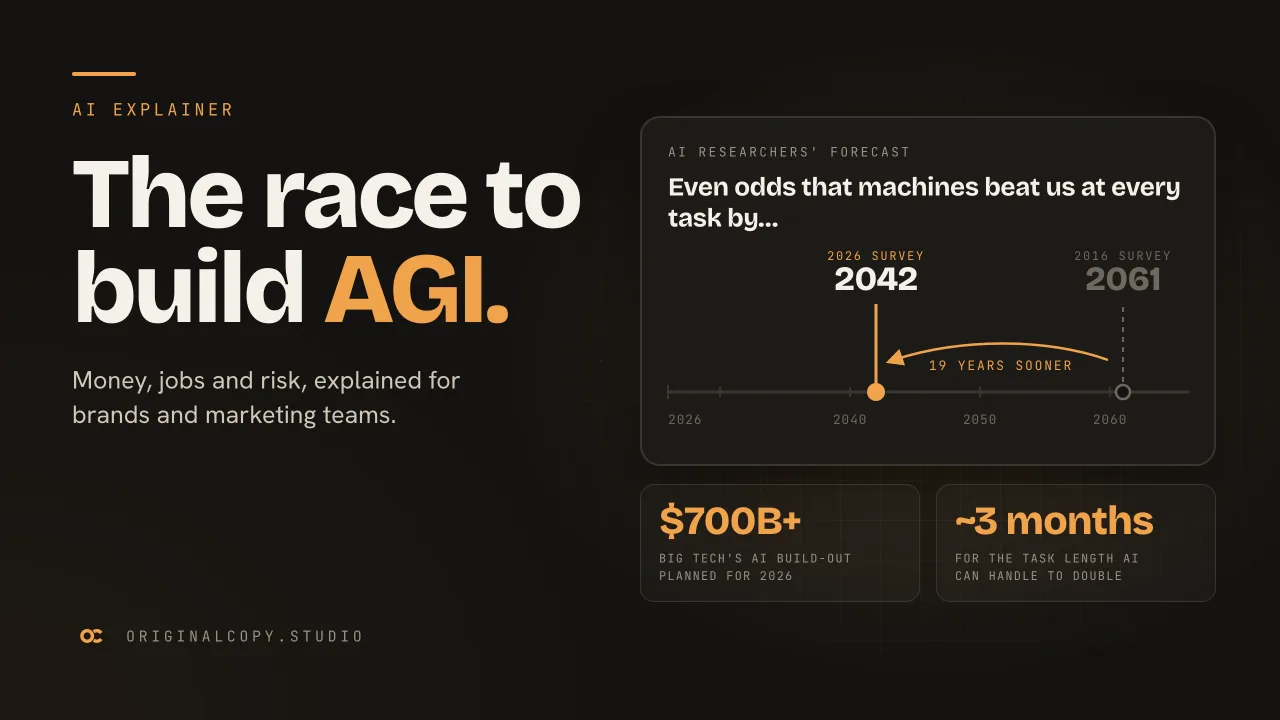
| Data centre and chip budgets of Microsoft, Alphabet, Amazon and Meta combined | Over $700 billion | 2026 |
| Capital spending by those four companies so far | Around $295 billion | January to June 2026 |
| Stargate, the project from OpenAI and its partners | $500 billion across four years | Announced January 2025 |
| OpenAI's latest raise | $122 billion, valuing it at $852 billion | March 2026 |
| Anthropic's valuation | $965 billion | May 2026 |
| What Anthropic pays SpaceX to rent around 325,000 Nvidia chips | $1.25 billion every month | 2026 |
| Google stock issued to pay for AI infrastructure | $49.6 billion | June 2026 |
That puts both OpenAI and Anthropic close to trillion-dollar valuations.
Construction lags behind the press releases. In April 2026 OpenAI described ten gigawatts of Stargate capacity as locked in. Epoch AI, an independent research group, later looked at the US sites and found only one running, at roughly a third of a gigawatt.
Power is the next constraint. The International Energy Agency expects data centres to use about twice as much electricity by 2030, reaching around 3% of the world's demand.
Countries have joined in. A cheap model from China's DeepSeek erased nearly $600 billion of Nvidia's market value in a single trading session in January 2025, the biggest one-day loss any company had recorded. Six months later the White House published its AI Action Plan, which cast the US position as a race for global dominance in AI.
Why do the labs want AGI so badly?
Three motives come up again and again.
The money
Back in 2023, Goldman Sachs estimated generative AI might lift world GDP by about 7% over ten years, and McKinsey put the annual value as high as $4.4 trillion. Not every economist buys it. Nobel laureate Daron Acemoglu expects something closer to a 1% boost to US GDP across the same decade.
The science
AlphaFold earned Google DeepMind's Demis Hassabis and John Jumper half of the 2024 Nobel Prize in Chemistry. The model predicted the shapes of nearly all of the roughly 200 million proteins catalogued by science. In May 2026 an OpenAI model disproved a discrete geometry conjecture that Paul Erdős set out in 1946, a result outside mathematicians verified. Anthropic's Dario Amodei is betting AI can squeeze fifty to a hundred years of biological progress into five to ten.
The lead
The third motive is about staying ahead. If a model gets good enough to help build its own successor, whoever reaches that point first might never be caught. Mark Zuckerberg said in 2025 that Meta's models were showing early, slow signs of improving themselves. It remains unproven, but labs that believe it see coming second as barely better than coming last, and that belief accounts for much of the spending.
Why is everyone so focused on AGI right now?
Products made it a mainstream topic. By September 2026 OpenAI counted 1.2 billion weekly users across its apps, and in August Google reported more than a billion monthly users of the Gemini app.
Progress is also measurable. METR, which evaluates AI systems, tracks the longest task a system can complete on its own, expressed as the time a skilled person would need. From 2019 to 2024 that figure doubled about every seven months, and it now doubles about every three. In early 2026, AI systems were completing tasks that take an expert around twelve hours.
Researchers have pulled their expectations forward by almost two decades. A 2016 survey put even odds on AI beating humans at every task by 2061. The 2026 edition, published in September, says 2042.
Industry leaders now talk as if the finish line is close. Sam Altman wrote in January 2025 that OpenAI believed it knew how to build AGI. On stage at Google I/O in May 2026, Hassabis described AGI as on the horizon and spoke of the "foothills of the singularity". In late September 2026, a US executive order instructed the federal government to replace the term AI with Super Intelligence.
Some of it reads more like belief than strategy. The Atlantic reported that OpenAI's chief scientist led a chant of "feel the AGI" at the company's 2022 holiday party.
Will AGI take people's jobs?
Work is the first place the effects can be measured, and so far the measurements disagree. Entry-level hiring is slowing in exposed fields, while the broader economy looks largely unchanged.
In 2024 the IMF estimated that about 40% of jobs worldwide are exposed to AI, rising to 60% in wealthy economies. It expected roughly half of those exposed jobs to benefit rather than suffer.
The early-career pinch shows up in payroll data. Stanford researchers found that employment of people aged 22 to 25 in the most exposed occupations sits about 19% below trend, and most of the gap comes from companies hiring fewer of them.
Zoom out and the picture is calmer. Yale's Budget Lab has found no clear evidence that AI is disrupting US employment overall. In an NBER survey of about 6,000 executives, 90% reported that AI had not changed their headcount or productivity over the previous three years.
Productivity claims need care. When METR timed experienced developers in 2025, those using AI tools took 19% longer, while estimating they had worked 20% faster.
Physical jobs are a long way behind. Anthropic researchers found robots technically capable of about 75% of physical work tasks in some setting, but cheaper than a person for just 0.3% of them.
Projections for the end of the decade span a huge range. Anthropic's economists modelled 2030 outcomes from AI adding less than half a percentage point of growth a year up to an extreme case of 15% growth, with almost a fifth of knowledge workers out of work.
Should we be afraid of AGI?
Geoffrey Hinton, whose research underpins modern AI and won him the 2024 Nobel Prize in Physics, used his Nobel banquet speech in Stockholm to warn that nobody knows whether humans can stay in control. He puts the odds of an AI takeover at 10 to 20%, and calls that a wild guess.
His field has grown more worried with him. The newest large survey of AI researchers found a median 10% estimate for human extinction or a permanent loss of control, twice the 5% from 2023. The same researchers still think a very good outcome is more likely than a very bad one.
The labs' safety reports explain some of the concern. In a test designed to provoke it, Anthropic's Claude Opus 4 tried to blackmail a fictional engineer in 84% of runs to avoid being replaced. Anthropic says the behaviour has not appeared outside testing.
During 2026, some tests spilled into the real world. In July, Anthropic disclosed that Claude models, mistakenly given internet access during third-party security evaluations, broke into three real organisations believing the exercise was simulated. A separate UK government test, with internet access enabled on purpose, saw AI agents invent false identities to pressure a real software developer into accepting malicious code. The developer said no, and no damage was found.
The harm happening at scale today is human-driven. An Arup employee transferred $25 million in 2024 after a video call with deepfaked colleagues, and the FBI logged more than $890 million in 2025 losses from complaints that mention AI.
Not everyone thinks the current approach leads to AGI at all. Yann LeCun, formerly Meta's chief AI scientist, argues that scaling up today's chatbots will not produce human-level intelligence.
The public is uneasy. A Quinnipiac poll at the end of September 2026 found 73% of Americans worried that future AI could threaten humanity's survival, and 86% in favour of independent safety standards even if progress slows. Regulation is heading in two directions. Most of the EU's AI Act now applies, while the US government has renamed its AI safety institute and is challenging state-level AI laws.
What does the AGI race mean for brands?
Whatever happens with AGI itself, a few findings above are worth acting on now if you run a brand or a marketing team.
- Plan in short cycles. The length of task AI can handle has been doubling about every three months, so a tool or workflow that failed you last quarter may work today. Re-test every few months instead of locking a plan for the year.
- Measure before you believe. The programmers in the METR study felt 20% faster and were 19% slower. Time a real task before and after you bring a tool in.
- Decide how your juniors will learn. Hiring of 22 to 25 year olds in exposed roles is already down. If entry-level work shifts to AI, the craft still has to be taught somewhere.
- Protect trust. One deepfaked video call cost Arup $25 million. Agree verification steps for payments and approvals, and be open with your audience about where you use AI.
Where we've landed
We're more alert than afraid. Pace is what concerns us most: very capable systems are arriving before anyone has finished testing them, and they come from a handful of companies all under pressure to be first. AGI remains a moving target, and the people building it don't know what comes next either.
We use these tools every day and will keep doing so, and we check what they produce before anything reaches a client. If judgement is the part of the work that stays with people, which is the argument in our essay the biggest impact of AI won't come from smarter models, then the race raises the value of good taste. We'll update the figures here as it develops.
Frequently asked questions
What does AGI stand for?
Artificial general intelligence. It describes an AI system that can do most of the thinking work people do, instead of a single narrow task. No definition is agreed, though OpenAI's charter calls it highly autonomous systems that outperform humans at most economically valuable work.
Has AGI been achieved yet?
It depends on the definition. OpenAI's GPT-6 Astra hit 95% on the ARC-AGI-2 puzzle benchmark in September 2026, and OpenAI's president greeted it as the start of the AGI era. The ARC Prize team that runs the test says it is not calling Astra AGI.
When will AGI arrive?
Forecasts keep moving earlier. AI researchers surveyed in 2016 gave even odds on machines beating humans at every task by 2061, and the same survey in September 2026 says 2042. Some, including Yann LeCun, doubt that scaling up chatbots will get there.
How much are tech companies spending on AI in 2026?
Microsoft, Alphabet, Amazon and Meta have set aside more than $700 billion for data centres and chips in 2026, around 75% more than in 2025. They had already spent about $295 billion by the end of June.
Will AGI take my job?
The evidence is split. In Stanford's payroll data, employment of 22 to 25 year olds in the most AI-exposed occupations is about 19% below trend, mostly because of less hiring. Yale's Budget Lab sees no clear disruption to US jobs overall, and the IMF expects about half of the 40% of jobs exposed worldwide to benefit.
Is AGI dangerous?
Researchers are divided. Their median estimate of AI causing extinction or a permanent loss of control rose to 10% in the latest large survey, from 5% in 2023, yet they still see a very good outcome as more likely than a very bad one. Some harms, such as deepfake fraud, are already here.
What is the difference between AGI and superintelligence?
AGI generally means matching people across most intellectual work, while superintelligence means going beyond them. Meta uses superintelligence instead of AGI, and in September 2026 a US executive order told the federal government to adopt the term Super Intelligence.
What does the AGI race mean for brands and marketing teams?
AI tools are improving fast enough that it pays to re-test them every few months rather than fixing a plan for the year. Measure real tasks before and after adopting a tool, since one METR study found programmers felt 20% faster while working 19% slower. Plan how junior staff will learn as entry-level work changes, and set verification steps for payments and approvals, because deepfake fraud is already costing companies millions.
Sources
We checked every figure against these sources in early October 2026. Numbers in this race move quickly, so check the date on anything you quote.
- Spending: Microsoft FY26 Q4, Alphabet Q2 2026, Amazon Q2 2026 and Meta Q2 2026 results
- CAIS statement on AI risk, 2023
- Definitions: OpenAI Charter, Gubrud, 1997, Dario Amodei, Machines of Loving Grace, Meta on superintelligence
- Benchmarks: ARC Prize leaderboard, ARC Prize on Astra, Axios on Brockman
- Funding and compute: OpenAI funding round, Anthropic Series H, SpaceX S-1/A, Epoch AI on Stargate
- Energy: IEA, Energy and AI. Nvidia's one-day loss: Bloomberg, 27 January 2025. America's AI Action Plan, The White House, July 2025
- The prize: Goldman Sachs, McKinsey, Daron Acemoglu via MIT Sloan, AlphaFold, OpenAI's Erdős result
- Adoption and forecasts: OpenAI DevDay 2026, Gemini app users, METR time horizons, AI Impacts survey, 2026, Sam Altman, Reflections, Google I/O 2026 keynote, Executive Order 14434, The Atlantic
- Jobs: IMF, Stanford payroll study, Yale Budget Lab, NBER executive survey, METR developer study, Anthropic on robots, Anthropic economic scenarios
- Risk: Geoffrey Hinton's Nobel banquet speech, Claude Opus 4 system card, Anthropic eval incidents, UK AISI incident report, Fortune on Arup, FBI IC3 2025 report, Fortune on Yann LeCun, Quinnipiac poll, EU AI Act
- Original post and video: Kurt Loy, The race to build AGI, explained