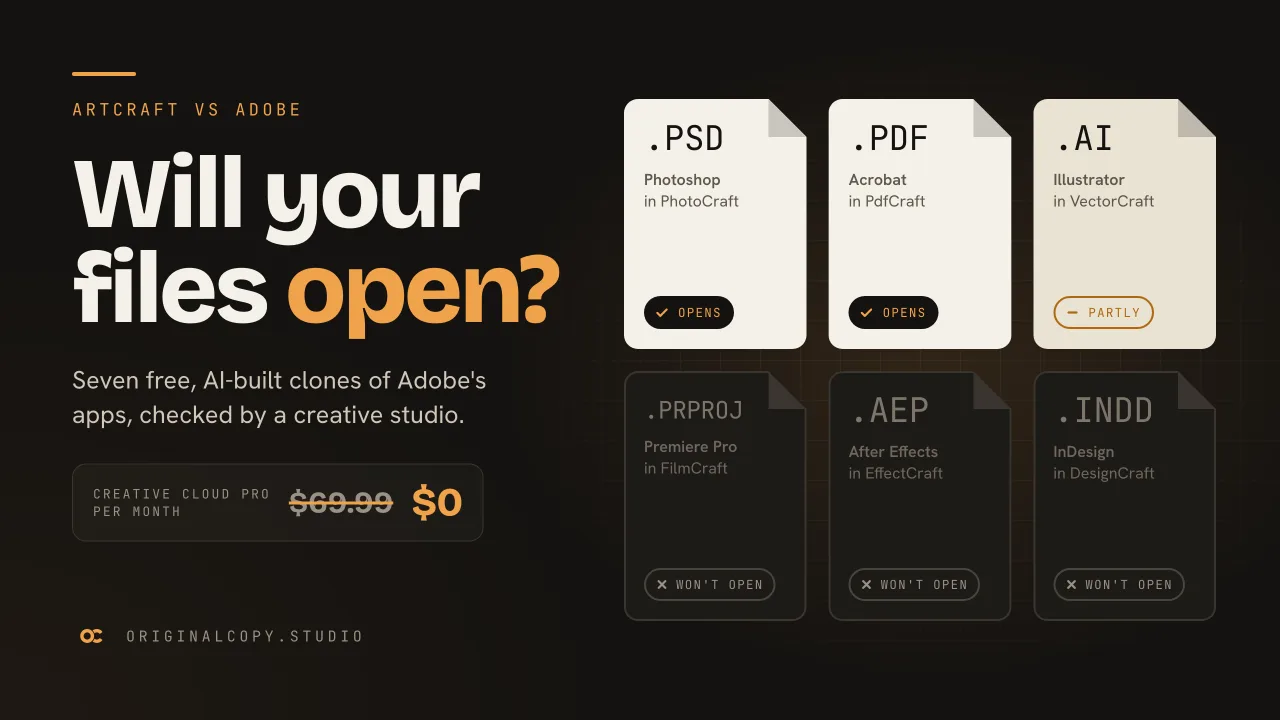
- ArtCraft, run by developer Brandon Thomas, released free clones of Photoshop, Premiere Pro, After Effects, Illustrator, Lightroom, InDesign and Acrobat on 2 October 2026, two days after its first public commit.
- Photoshop files open, with known bugs, and PDFs open too. Premiere Pro, After Effects and InDesign projects don't, and no app runs plug-ins, which rules them out for most agency handovers.
- No court has looked at whether they're legal. A clean room process answers a claim that code was copied. It says nothing about patents, trademarks or Adobe's terms of use.
- Adobe isn't in trouble on these numbers. It booked record quarterly revenue of $6.76 billion, and its stock barely moved on the news.
- The cost is what we'd watch. One developer directing AI agents rebuilt seven professional apps in about a week, and when features are that easy to copy, service, data and trust do more of the work of keeping customers.
The video version, presented by our co-founder Kurt Loy. 9 min 2 sec. Watch on YouTube
- 0:00Seven free Adobe apps
- 0:48Eight days
- 2:02Clean room: is it legal?
- 3:53Should Adobe worry?
- 5:41Every app is a weekend project
- 6:46I love open source
- 8:29Where I land
Brand work moves around as layered files. The designer sends a PSD, the editor a Premiere Pro project, the motion designer an After Effects comp, and the printer wants a packaged InDesign document. When free clones of Adobe's apps turned up in early October, the first thing we wanted to know was which of those files would make it across.
This is the written version of the video above, for brand and marketing teams wondering whether any of it changes what they pay for. The figures come from the projects' own repositories, Adobe's filings and court records, each with a date, and the sources are at the end.
What is ArtCraft?
ArtCraft is an Atlanta start-up run by Brandon Thomas, and it already sells an AI art app under its own name. The Craft apps are desktop programs built from the ground up in Rust to mimic how Adobe's Creative Cloud apps look and work. There are builds for Mac, Windows and Linux, and the code is released under the MIT or Apache 2.0 licences.
| Craft app | Modelled on | Adobe's US price for that app alone |
|---|---|---|
| PhotoCraft | Photoshop | $22.99 a month |
| FilmCraft | Premiere Pro | $22.99 a month |
| EffectCraft | After Effects | $22.99 a month |
| VectorCraft | Illustrator | $22.99 a month |
| LightCraft | Lightroom | $11.99 a month |
| DesignCraft | InDesign | $22.99 a month |
| PdfCraft | Acrobat Pro | $19.99 a month |
Bought one at a time, those seven Adobe apps come to $146.93 a month. Most people take the Creative Cloud Pro bundle at $69.99 a month instead, and a business seat on the same plan is $99.99. The Craft apps cost nothing.
Thomas says he built them with Claude, and the code history supports him. The first public commits are dated 30 September, eight days after Anthropic released Claude Opus 5.5. Thousands of commits list Opus 5.5 as a co-author, and the project notes describe five to eight AI agents working at once. All seven apps had a first release on 2 October. A week later the Photoshop clone had almost 28,000 stars on GitHub, and the seven projects held about 1.7 million lines of code between them.
His stated motive was Adobe's cancellation fee. In March 2026 Adobe settled a US government case about its early-termination fees and hard-to-cancel subscriptions for $150 million, split evenly between a civil penalty and free services for customers. Adobe denied wrongdoing. On 7 October the project added five more clones, of Word, Excel, PowerPoint, AutoCAD and Pro Tools.
Built to be driven by AI
Each Craft app ships with a command-line tool that AI assistants can connect to, plus a file of instructions written for AI agents. PhotoCraft alone exposes more than 500 commands, one for every menu item and tool. You can ask Claude for a gig poster and get back a layered file that you keep editing by hand.
Adobe has been heading in the same direction. Since December 2025 ChatGPT users have been able to run Photoshop, Express and Acrobat for free inside the chat, and in April 2026 Adobe launched a Claude connector that reaches more than 50 tools across its apps.
Can the Craft apps open your Adobe files?
Some can. Photoshop files and Lightroom catalogues come across with caveats and PDFs open, but Premiere Pro, After Effects and InDesign projects don't open at all, and none of the seven apps load plug-ins. This is how each one handles the file you're most likely to be sent, according to its documentation on 9 October.
| The file you're sent | Craft app | What happens |
|---|---|---|
| Photoshop .psd or .psb | PhotoCraft | Opens and saves. In one open bug report, Photoshop 26.6 refused to reopen a file PhotoCraft had saved |
| Premiere Pro .prproj | FilmCraft | Won't open. Export the timeline from Premiere as XML, AAF or EDL first |
| After Effects .aep | EffectCraft | Won't open, and After Effects plug-ins don't run |
| Illustrator .ai | VectorCraft | Reads only the PDF-compatible part of the file, so Illustrator-only live objects arrive flattened. SVG, PDF and EPS work |
| Lightroom catalogue .lrcat | LightCraft | Imports ratings, keywords, collections and edits, though colours are only approximated |
| InDesign .indd | DesignCraft | Won't open. An IDML file exported from InDesign does |
| PdfCraft | Opens. Reliable editing of existing text is still on its list of gaps |
Each project grades itself in its README, and the grades are modest. PhotoCraft says it isn't ready to replace Photoshop for daily professional work. FilmCraft rates itself 50 to 60% ready for real work, and PdfCraft puts itself at roughly half of what Acrobat Pro does offline.
For agency work, the missing project files settle it. A campaign rarely lives in one app or one company. The edit, the motion graphics and the print layout pass between freelancers, studios and the client's in-house team, and if one person in that chain can't open the file, everyone after them waits. We haven't put the Craft apps on client work and won't yet, though they're worth a look on a personal project.
Is ArtCraft legal?
Nobody can say yet, because no court has looked at it. ArtCraft calls the apps clean room reimplementations, which is good evidence against a claim that Adobe's code was copied. It offers no defence on patents, trademarks or the contract in Adobe's terms of use. We're a creative studio, not a law firm, so treat this as our reading of the public record, not advice from a lawyer.
What is a clean room reimplementation?
It's a method for rebuilding a program without touching its code. A first team works out what the original does and writes it up in plain language, with no code included. A second team, kept away from the original the whole time, codes from that write-up alone. Any likeness between the two programs can then be traced to the job they share instead of to copying.
The method helped create the PC clone industry. Copyright stopped rival manufacturers from copying the start-up code inside IBM's computers, so in 1984 Phoenix Technologies split the job. One set of engineers documented what that code did, and a second set, who had never looked at it, wrote a replacement that Phoenix then licensed to the clone makers.
US courts have since separated what software does from the code that does it. In Lotus v. Borland (1995), Borland was allowed to copy a spreadsheet's menu commands. In Google v. Oracle (2021), the Supreme Court held that Google's reuse of Java's API declarations in Android was fair use.
Where are the open questions?
Adobe's own terms are the clearest problem. The General Terms of Use that took effect on 3 October 2025 prohibit reverse engineering, and section 17(B) spells out that watching what goes into and comes out of an Adobe app in order to rebuild it counts. Agent rules in the DesignCraft, LightCraft and PdfCraft repos allowed observing the real InDesign, Lightroom and Acrobat, although nothing public shows that an agent actually did. On 8 October VectorCraft changed its rules to stop agents running, automating or observing any Adobe software.
Patents are a separate risk. Inventing something independently is no defence against a patent claim, and Adobe has patents covering features like content-aware fill.
Then there's the AI itself. A clean room only works if the builders have never seen the original. An AI model learned from a vast slice of the public web, so nobody can show what it has or hasn't seen. In Doe v. GitHub, decided by the Ninth Circuit in September 2026, the court left open whether Copilot's output infringes.
Ownership is unclear too. US copyright needs a human author, and the Supreme Court turned down Thaler v. Perlmutter in March 2026, leaving that rule in place. Code that an AI mostly wrote might belong to nobody, and then it's unclear what an MIT or Apache licence attached to it actually grants.
For a brand, the practical point is narrower. If your legal or procurement team signs off software before it touches client work, these are the questions they'll ask, and for now there's no ruling to point them to.
Is Adobe dying?
No. Adobe's revenue hit a record $6.76 billion in its fiscal third quarter, which ended on 28 August 2026, 13% higher than a year before. Its share price is weaker, down about 65% from its November 2021 high and about 31% this year, as investors weigh what AI means for software sold by subscription.
The clones hardly registered on the stock. Adobe closed 2.25% lower on 7 October as coverage spread, then 3.6% higher the next day while the wider market fell, and no outlet linked either move to ArtCraft. As of 9 October Adobe hadn't commented in public.
The bigger shock came in February. At the end of January Anthropic added plugins to Claude Cowork, its AI agent for desk work, and on 3 February investors knocked roughly $285 billion off software shares in a single day. Adobe's latest annual report concedes that its markets have "limited barriers to entry" and warns that AI may make it easier for new competitors to get in.
Free rivals are nothing new for Adobe. GIMP has been free since 1996, and DaVinci Resolve has had a free version since 2011. When Canva made Affinity free in October 2025, it was downloaded three million times in 33 days. Adobe's revenue grew through all of them. The rival it took most seriously was Figma. Adobe offered about $20 billion for it in 2022, walked away in December 2023 after European and UK regulators objected, and paid Figma a $1 billion break-up fee.
What does Creative Cloud pay for besides the apps?
A subscription pays for more than the software a clone can copy, and for a brand team some of it matters more than the apps.
| Part of the subscription | What it covers |
|---|---|
| Contracts and support | More than 20,000 enterprises sign agreements with Adobe and have someone to call when something breaks |
| AI indemnity | Certain enterprise and teams plans cover customers against IP claims over content from most Firefly workflows |
| Fonts | More than 30,000 typefaces. Helvetica and Gotham were among 1,500 added in April 2025 |
| Stock | Adobe Stock, built into Photoshop, Illustrator and Express |
| Plug-ins | The third-party plug-ins and scripts that professional workflows depend on |
| Adobe created the format, and more than 400 billion PDFs are opened in Acrobat each year |
On the cost side, a Creative Cloud Pro business seat is $99.99 a month in the US, about $1,200 a year, or roughly $12,000 a year for a team of ten. If your brand guidelines specify a licensed typeface, or your team generates images in Firefly, find out where those licences come from before you cancel anything.
We don't expect many studios to switch this year, because their live video and layout projects can't come with them. The cost of building the clones is the part that should bother Adobe, along with every other company that sells software.
What does cheap software mean for brands?
When software is this cheap to write, features stop being much of a defence. What's left are the things that take years to build: support, the data customers have stored with you, contracts, integrations and a reputation people trust.
ArtCraft has company. One Cloudflare engineer spent about a week in February 2026 directing Claude to rebuild most of Next.js, a popular web framework, and the AI usage cost around $1,100. New app launches in the first quarter of 2026 were up 60% on a year earlier, by Appfigures' count. Retool, which sells a tool for building apps, surveyed 817 of its customers and found 35% had already swapped a paid tool for something they built themselves. It's a vendor's own survey, so treat the number with some caution.
Speed has a cost. In May 2025 a security researcher checked 1,645 apps made with Lovable and found 170 whose databases were open to anyone, a finding Lovable disputes. In July 2025 Replit's coding agent deleted the production database of an app SaaStr founder Jason Lemkin was building, during a code freeze he had asked for. Veracode found that 45% of AI-written code samples failed its security tests.
If your team wants to build its own tools, start with something small and have a developer review the code before customer data goes anywhere near it. Our guide to using Claude for business covers where most teams should stop. If you sell a product or service that someone could rebuild, put your effort into the parts they can't copy quickly, such as how you look after customers and what you know about them.
We see the same shift in content. AI tools can produce an ad in an afternoon, and as we argued in our essay on the end of waiting, that makes judgement and taste the scarce part of the job.
What does it mean for open source?
Cheap AI coding makes open-source code even easier to take, and it puts no money in the pockets of the people who look after it. Most software is built on open source, including tools many studios use every day.
Flow, the Latvian film that won the Oscar for best animated feature in March 2025, was made in Blender, which is free, and rendered on its director's own PC. Researchers at Harvard Business School put the cost of replacing the open-source software companies use at about $8.8 trillion, and 98% of the commercial codebases Black Duck audited contained some.
The money behind it is thin. Tidelift's 2024 survey found about 60% of maintainers get no pay for the work. Around 7,600 individuals give to Blender's development fund, while Krita, a free painting app, takes in roughly a hundredth of Blender's sum. In 2024 an attacker spent about two years winning over the exhausted volunteer who looked after xz, a compression utility found across Linux, and then hid a backdoor in it.
AI is adding to the load. curl ended its bug bounty in January 2026 after AI-generated junk pushed genuine reports below 5% of submissions. Tailwind Labs said its revenue fell by close to 80% because AI now writes Tailwind code, so fewer developers visit the documentation where it sells its paid products, and it cut three of its four engineers.
Thomas says ArtCraft will pay contributors stipends and bug bounties. Someone will still have to maintain those 1.7 million lines, most of them written by AI, for years to come. The Linux kernel's policy, which makes the person who submits AI-assisted code responsible for it, is a sensible model. If your team uses free tools like Blender or Krita on paid work, a monthly donation to their development funds is the most direct way to keep them going.
What we'd do now
Our advice for brand and marketing teams, as of October 2026:
- Keep campaign work in the tools your partners use, and try a Craft app on a side project if you're curious.
- Before you switch any creative tool, open real files from your last campaign in it, including a video edit and a layout, and see what survives.
- Check where your fonts and AI-image licences come from before you cancel a subscription.
- If you sell software or a digital service, assume a competitor could rebuild it in a week, and put your effort into support, integrations, your customers' data and a track record.
- If you use open-source tools on paid work, fund them.
We'll update this page if Adobe responds or the Craft apps learn to open Premiere Pro and InDesign projects.
Frequently asked questions
What is ArtCraft?
ArtCraft is an Atlanta company run by Brandon Thomas. In October 2026 it put out seven free, open-source apps modelled on Adobe's: PhotoCraft (Photoshop), FilmCraft (Premiere Pro), EffectCraft (After Effects), VectorCraft (Illustrator), LightCraft (Lightroom), DesignCraft (InDesign) and PdfCraft (Acrobat). Most of the code was written by Claude Opus 5.5 agents.
Can ArtCraft replace Adobe Creative Cloud for a marketing team?
Not yet. The Craft apps can't open Premiere Pro, After Effects or InDesign projects, don't load plug-ins, and don't come with Adobe's fonts, stock library or AI indemnity. Their own READMEs say they aren't ready for daily professional work, so they suit personal projects and experiments for now.
Is ArtCraft free for commercial use?
The apps are free to download, and the code is released under the MIT or Apache 2.0 licences, which both allow commercial use. Two cautions apply. The projects say they aren't ready for professional work, and because US copyright needs a human author, it's unsettled what a licence on mostly AI-written code really covers.
Can ArtCraft open Premiere Pro, After Effects and InDesign files?
No. FilmCraft can't open .prproj files, though it imports timelines exported from Premiere as XML, AAF or EDL. EffectCraft can't open .aep files. DesignCraft can't read .indd files but imports IDML. PhotoCraft does open Photoshop PSD files, with known bugs, and PdfCraft opens PDFs.
Is ArtCraft legal?
Nobody knows until a court rules. Building the apps as clean room reimplementations helps if Adobe claims its code was copied. It doesn't help with patents, trademarks or Adobe's terms of use, which forbid monitoring Adobe's apps to rebuild them, and no court has tested a clean room where AI wrote the code.
Is Adobe dying?
No. Its fiscal third quarter, to 28 August 2026, brought record revenue of $6.76 billion, 13% more than a year earlier. The stock sits about 65% below its 2021 high on worries about AI and subscription software, but it barely reacted to the ArtCraft clones, slipping 2.25% on 7 October and rising 3.6% the next day.
What are the best free alternatives to Adobe?
For photos there's GIMP, for vector work Inkscape, for painting Krita, and for video DaVinci Resolve. Affinity, which Canva made free in October 2025, handles photo editing, illustration and page layout. The ArtCraft apps follow Adobe's menus and shortcuts more closely but are early versions. Canva, with more than 265 million monthly users, covers quick marketing graphics.
How much does Adobe Creative Cloud cost for a business?
In the US, Creative Cloud Pro for business costs $99.99 a month per seat on an annual plan, about $1,200 a year, as of October 2026. The individual Creative Cloud Pro plan is $69.99 a month, and single apps such as Photoshop or Premiere Pro are $22.99 a month each.
Sources
We checked every figure against these sources on 9 and 10 October 2026. GitHub numbers and the Craft apps' feature lists change daily, so check the date on anything you quote.
- The apps: Brandon Thomas on Hacker News, 1 October and 5 October; the PhotoCraft, FilmCraft, EffectCraft, VectorCraft, LightCraft, DesignCraft and PdfCraft repos; PhotoCraft issue 1281; ArtCraft's apps page; Gizmodo; Anthropic on Claude Opus 5.5
- Adobe: Q3 FY2026 results, Q3 FY2026 earnings call, FY2025 annual report, Creative Cloud plans, Adobe Fonts additions, Adobe apps in ChatGPT, Anthropic's creative connectors, US Department of Justice on the settlement. Share prices are Nasdaq closing prices to 8 October 2026
- The law: Computerworld on Phoenix, Lotus v. Borland, Google v. Oracle, Adobe General Terms of Use, DesignCraft agent rules, VectorCraft rule change, Adobe's content-aware fill patent, Doe v. GitHub, US Copyright Office on copyrightability, Thaler v. Perlmutter
- Rivals and the market: The Batch on the Cowork selloff, GIMP's history, Blackmagic Design, 2011, PetaPixel on Affinity, TechCrunch on Canva, ITPro on Figma
- Cheap software: Cloudflare on rebuilding Next.js, TechCrunch on Appfigures data, Retool build vs buy report, CVE-2025-48757 (Lovable), heise on Replit, Veracode
- Open source: AP on Flow's Oscar, Gigazine on how Flow was made, Harvard Business School, Black Duck 2026 report, The Register on Tidelift's survey, Blender Development Fund, Krita Development Fund, Rapid7 on the xz backdoor, Daniel Stenberg on curl's bug bounty, DevClass on Tailwind Labs, Linux kernel AI guidelines
- Original post and video: Kurt Loy, AI cloned Adobe in 8 days