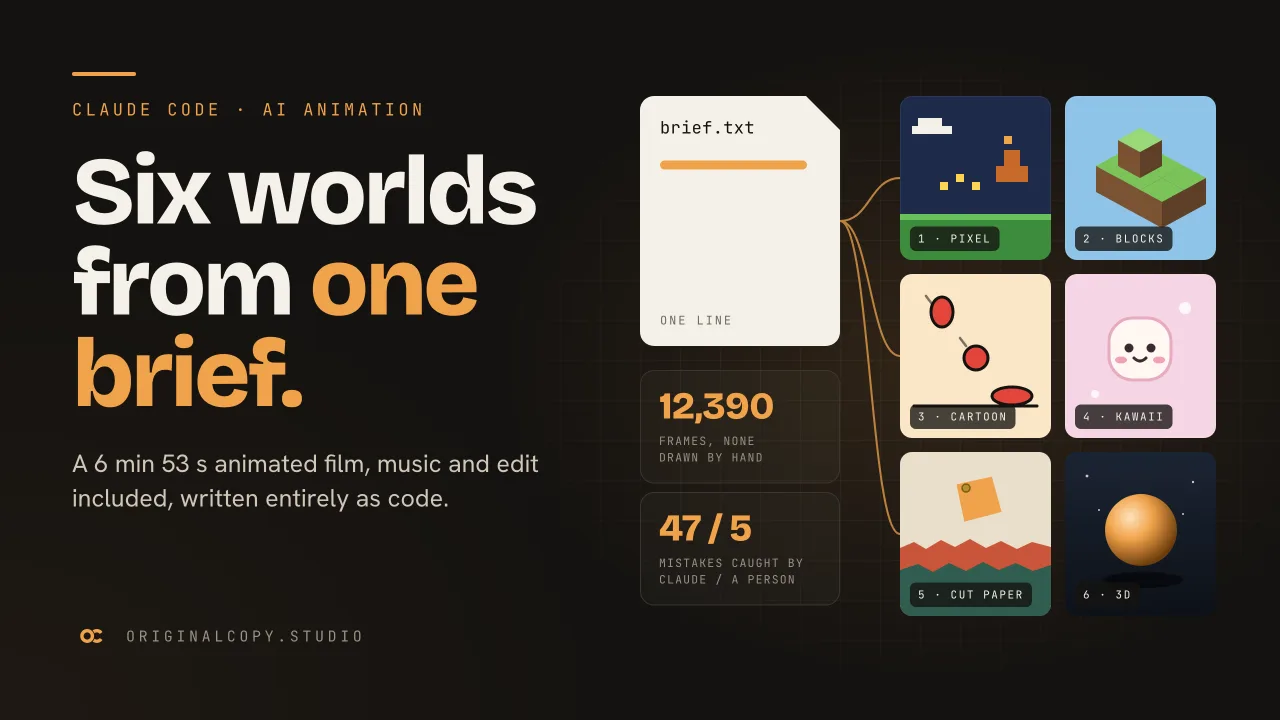
- Claude Code makes animation by writing each scene as a web page, which a renderer captures frame by frame.
- It never draws a frame. It writes rules for how things move over time, and the renderer works out all 12,390 frames.
- The music and sound effects are code too, synthesised from note data and filtered noise rather than taken from a library.
- The edit is a text file. Change a line of the script and every scene, card and caption moves to match.
- It caught 47 of its own mistakes. I caught 5, and every one of mine was about how the film sounded or flowed.
The video version, 6 min 53 sec. Watch on YouTube
- 0:00The brief
- 0:36How a video can be code
- 1:33World 1: pixel art
- 2:19World 2: blocks
- 2:56World 3: cartoon
- 3:34World 4: kawaii
- 4:11World 5: cut paper
- 4:49World 6: 3D
- 5:22Sound and the edit
- 6:04The scorecard
The project began with one message typed into a terminal:
let's see what you can do with the script, the animation, the sound design and the edit. Pixel art, a first-person block world, cartoon, kawaii, stop motion and 3D.
After that I stopped touching it. Claude Opus 5.5 generated every frame, sound and cut in the finished film as code. My part was the brief, an approval at each stage, and a log of everything that went wrong. The log ended up with 52 entries.
For a studio that makes brand films, I treated this as a test of where the human work now sits. The answer turned out to be very specific.
How does Claude Code make animation?
Not the way the question suggests. Claude cannot draw and it cannot watch video. It writes programs that draw, then looks at still images of what those programs produced.
A web page can render almost anything, from a flat rectangle to a lit 3D scene. So each scene in the film is a web page, written in HTML, Canvas, SVG or Three.js depending on the style. HyperFrames, HeyGen's open-source renderer, loads the page and captures it one frame at a time at 30 frames per second.
Nothing is animated by hand. Position, rotation and colour are all written as functions of time, so a foot at frame 400 is wherever the maths puts it. Claude writes the rule once and the renderer works out every frame from it.
The way it checks its own work was the most revealing part. Because it cannot play a video back, it renders a few stills after each change and reads them as images, much as you might glance at a photo before sending it. When a still looks wrong, it goes back into the code. That loop is why it caught most of its own mistakes.
The six worlds
A code-drawn version of me, orange spikes and a black sweater, had to survive six visual styles that share no assets and barely share a rendering method.
| World | Style | Built with | What broke on the first render |
|---|---|---|---|
| 1. Pixel art | A 1980s console game, 320 pixels wide, scaled up with no smoothing | Canvas, with square-wave music from a list of notes | The character came out 19 pixels tall, too small to carry a scene |
| 2. Blocks | First-person voxel landscape | Seeded noise for the terrain | The walk path ran through two trees, so eight seconds showed nothing but leaves |
| 3. Cartoon | Squash, stretch and anticipation | Damped oscillation for follow-through | The speed lines sat too low and made him look like he was on stilts |
| 4. Kawaii | Round, pastel, objects with faces | Soft corners, a settling bounce, no hard shadows | Rounding off the shapes turned his spikes into a mop and lost the likeness |
| 5. Cut paper | Torn edges, brass pins, drifting outlines | SVG with a wobble on every point of every edge | A waving arm swung behind his head and disappeared |
| 6. 3D | Real lights, shadows and a moving camera | Three.js in the same web page | It crashed before drawing a frame, and a later version showed ten seconds of a black rocket against a black sky |
Three details stood out.
The pixel world's soundtrack is arithmetic. Claude wrote the melody as note data, and a few lines of maths turned the notes into square waves, which is how consoles of that era made sound. The canvas is 320 pixels wide because that is what a Mega Drive put out in 1988, and it is enlarged without interpolation so every pixel stays a hard square.
The cartoon world follows rules from the 1930s: squash and stretch, a crouch before a jump so the audience sees it coming, and follow-through so things settle instead of stopping dead. The principles came out of the Disney studio and were later written down by Thomas and Johnston in The Illusion of Life. Watch the mug after it lands. The wobble is a damped oscillation, and how quickly it dies away is a single number in the code.
The 3D world borrows from my desk. The rocket in world six is the model on the shelf behind me in my other videos. It took two failed attempts to get it off the ground, including the one where it sat black against a black sky for ten seconds before anyone noticed.
Can AI make the music and the edit too?
Here it did, without a sample library. A jump is a tone that slides upwards. A landing is noise, cut off almost immediately. The rustle in the paper world came from running noise through filters until it stopped sounding like static and started sounding fibrous.
The edit surprised me more. There is no timeline anywhere in the production. The narration script is a text file: Claude reads it, works out how long each sentence takes to say, and places every scene, chapter card and caption against those timings. Rewrite one line and the whole edit reflows around it, which no conventional editing software does.
It is the same idea I described in how Claude Code runs my creative studio, pushed further: here the finished film is generated rather than assembled.
What did Claude get wrong, and who caught it?
I logged every error from the first render onwards. By the time I recorded the narration, the count stood at 47 mistakes Claude found and fixed in its own work, and 5 that got past it to me.
Two of its catches show the range. It had scheduled the closing fade six seconds late, because its speech-timing check heard a "thank you" in the silence after my last line. In another pass, it noticed that every chapter card was preceded by almost a second of empty screen.
My catches were duller and more human. The clearest: at every scene change, the music from the outgoing world was still playing under the incoming one. No still frame will show you that.
All five of mine were like that. Each was about how the film sounded or how it flowed, which are the two things you cannot check in a screenshot.
What does "made alone" actually mean?
Two things came from a person. The narration is my voice, reproduced by an ElevenLabs clone, and every stage went through my approval before it moved on.
Everything else, every image, every sound effect and every cut, came from code Claude wrote, and it found most of its own errors without being told.
What it could not do was hear. Everything in my column came down to that. A system that checks single frames will never notice music smeared across a cut, because that only exists over time.
What this means for brands commissioning motion work
Nobody animated, scored or cut this film in the usual sense, and it still came out watchable. The part that did not get cheaper is the judgement at the end: noticing that the pacing drags, that the sound bleeds across a cut, that a moment lands flat. That is where a person still earns a place in the process, and it is the argument I made in the biggest impact of AI won't come from smarter models.
If you are planning AI into your next campaign film, decide early who will be checking the parts a screenshot cannot show.
The model doing the work here was Opus 5.5, and which Claude model to use compares it with the rest of the range.
Frequently asked questions
Can Claude Code make animation?
Yes, indirectly. Claude cannot draw or play back video. It writes each scene as a web page in HTML, Canvas, SVG or Three.js, and a renderer captures the page frame by frame into a video file. In this project every scene, sound effect and cut was made that way from a one-line brief.
How does code become a video file?
Through a renderer that treats a web page as a film. HyperFrames, HeyGen's open-source tool, loads the page and captures it one frame at a time at a fixed rate, 30 frames per second here. Because the scene is driven by time, the renderer can ask the page what it looks like at any moment and capture exactly that.
Does Claude draw every frame?
No. Position, rotation, scale and colour are written as functions of time, so the code describes a rule rather than a picture. This 6 minute 53 second film has 12,390 frames, and the renderer derives every one of them from those rules.
Can Claude watch the animation it makes?
Not as video. After each change it renders a few still frames and reads them as images to check its work. That means it reliably catches problems visible in a single frame, but misses anything that only exists over time, such as music overlapping a scene change.
Did Claude compose the music and sound effects?
Yes, all of it synthesised in code with no sample library. Melodies were written as note data and turned into square waves for the retro sections, the way 1980s consoles made sound. A jump is a rising tone, a landing is sharply clipped noise, and the paper texture is noise run through filters.
How do you edit a video without a timeline?
The edit is a text file. Claude reads the narration script, works out how long each sentence takes to say, and places every scene, chapter card and caption against those timings. Change one line and the whole edit reflows automatically, which conventional editing software cannot do.
How many mistakes did Claude make?
The log recorded 52 issues. Claude found and fixed 47 in its own work, including a closing fade scheduled six seconds late and a draft where every chapter card had almost a second of blank screen before it. Five reached the human reviewer, and all of them were about sound or pacing.
What did a human do on the project?
Two things. The narration is a human voice, reproduced through an ElevenLabs clone, and a person approved each stage before it continued. Every visual, every sound effect and the whole edit came from code Claude wrote.
Do you need to be a programmer to make animation with Claude Code?
No, but you need to describe what you want clearly and judge whether the result is right. This project started from one sentence naming four jobs and six styles. Nobody opened or edited the code by hand, but someone did have to watch the output and say when it was wrong.
Which Claude model made the film?
Claude Opus 5.5, running in Claude Code. Its ability to work unsupervised across a long task made a project of this size possible, with the model checking and correcting itself between sessions.
Sources
The tools behind the film: